
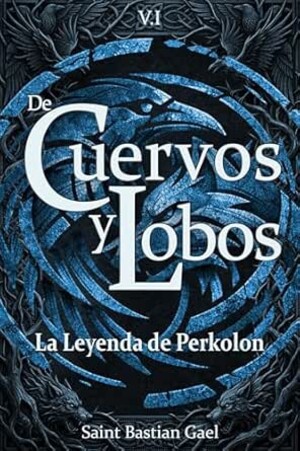
De Cuervos y Lobos (La leyenda de Perkolon 1)
© inepub.com
I - Blood of Kings An Empire is Born
Steeds cloaked in shadow galloped across the rain-soaked earth. Cloaks snapped in the wind — there would be no mercy for any found on the far side of the line of conquest. The bite of early winter tore at their garments and rusted their chainmail.
Warning trumpets rang out from the top of the wall.
The watchman in the north tower was the first to spot enemy troops advancing on the fortress.
Shrill, drawn-out blares seeped through every crevice of the citadel and the castle.
They were under attack — and with the swiftness of those who know exactly what to do, the first squadron of mounted soldiers rode out to meet them and halt their advance.
But the moment they crossed the gate, another alarm rang out.
The eastern tower: another group was coming.
It was not an invasion. It was a siege.
The Raven’s Standard was raised to the tip of the spear, and mounted on his black steed — clad in shining armour, red cloak and black coat — Narg Hugnork, heir of Odín’s raven, his war crown upon his brow, crossed the bridge at the head of his troops.
He would not remain sheltered within his castle.
He was not that sort of man. He would ride into battle, as he had done so many times before, with his men at his side — even at the cost of his own life.
From the battlements, bows already strung, they watched them ride out.
Between the king and the rest of his soldiers, the perfect formation of his eight elite warriors and counsellors rode at full gallop.
They were easy to distinguish — like their king, they wore red cloaks embroidered with a golden raven.
Their armour, too, was unlike any other: light, platinum-blue, with pauldrons shaped like feathers of thin, overlapping layers of metal.
They wore no helmets, but chainmail covered their heads, a ridge running down from between their brows to the bridge of their nose.
The blare of the trumpets changed its tune.
The group of villagers living on the outskirts of the castle recognised the call and ran to seek shelter within the walls.
They knew their homes would be destroyed to clear the battlefield, but more importantly: to prevent the enemy from taking any kind of refuge.
Narg rode to what he thought would be the point of collision between the two advancing forces and raised his hand. They were prepared, though they never imagined they would have to use it.
From the eastern wing of the wall, a hundred flaming arrows lit up the overcast sky that concealed the fading, slender silhouette.
Aiming to halt the attack on two fronts, they flew over the enemy battalion.
That was not their target, but the bridge linking Old Minister and Tloston across the Strait of Grosk.
It stood over the River Indralor, which flowed into the Santiana Sea, with a distinctive stony colour caused by the carbonite sediment in its waters. The only bridge in the entire kingdom built of timber was, like the riverbanks, coated in resin.
The wood lit up the night, and the burning carbonite, billowing thick smoke, made it impossible for anyone nearby to breathe.
From the heart of Old Minister, the third and fourth platoons emerged as a shock force.
The first charged straight at the northern contingent, whilst the other, torches and maces in hand, headed towards the cluster of adobe huts that made up the small village near the walls.
The flames provided light and cast shadows.
Narg assessed the situation. A swift response was essential — regroup his men, halt the advance. He turned in the saddle and watched the troop commander raise both arms wide, signalling the Raven Formation.
They wheeled right at full gallop, bearing down on the small group that had managed to cross the bridge, taking position as they rode.
Half the platoon pushed to the front. Fifteen soldiers, lances levelled, formed the sharp point. Behind them the rest fanned out horizontally, a semicircle that — like the wings of a raven — would serve as the first line of engagement.
Narg, with four of his retinue, moved to the right, just behind the defensive line; the others went left.
Both groups held ready, like talons poised to dismember, rend and annihilate any enemy that broke through.
At the commander’s signal the line would open, and they would surge forward in a swift strike before pulling back.
The last, smaller group held the rear. Arrows nocked, they would stop anyone who tried to reach the castle.
A flawless mass assault — black and gold cloaks billowing in the wind, drenched in rain and sleet — swept the enemy from the field. No prisoners had been Narg’s motto, but he had to break it. He wanted information.
Wolest, from the lands of Tloston on the eastern continent, had joined forces with Ubberia, its neighbour to the north — the last territory of Móntria that remained to be conquered before Old Minister and the Raven’s Standard could be transformed into an empire.
They wanted to dethrone him, that much was clear, but at least, with that small victory, they could only attack him head-on.
The tenth dawn found them with swords drawn and helmets pulled down over their faces.
A hundred of their men had fallen, yet they still held the upper hand in the defence of their lands.
Their feet still stood on Old Minister, but they were close to the border.
Thanks to Narg’s infallible tactics, they managed to push the enemy troops back to the banks of the River Ingalar, which separated the kingdoms, leaving them with only one route across.
Mounted on his black steed, he rode with his retinue to the summit of one of the hills bordering the River Ingalar. The field, filled with the banners of Ubberia and Wolest, was carpeted in green and burgundy across the plain. He made a quick count. They outnumbered him fifteen to one.
Narg read the field. As he spoke with his warriors he began removing his armour, piece by piece — including his crown, which he set down to rest upon one of the rocks.
He unburdened his body and his mind — his grey hair, shoulder-length, lifting free in the merciless wind that lashed at them — and so succeeded in summoning the part of himself that was legend, invoking the legacy of the legendary Alfredo, the raven’s blood that ran through his veins.
Odín blessed him, and that helped him regain his strength.
He had to use this to his advantage, since his mere presence was enough to command respect.
He embodied the Truth, holding aloft the ideals of his ancestors as a banner: equality, justice and honour took precedence over any of his own desires for power.
There was no people or kingdom, king or peasant, who did not know his name.
They feared and admired him, the perfect blend of power and kindness.
As he passed, they whispered the stories, ballads and odes composed for his legend that made him seem invincible, and so he was, as long as he had his small elite by his side and the ravens flying above his head.
But that greatness did not deter him from the duty of analysing his actions dispassionately and acting with caution in his decisions.
Power by conquest never struck him as a good deal, and for five years he sought a peace and trade agreement with Ubberia.
He had been on the verge of offering Halfdan the chance to remain on the throne in exchange for allowing him to have a say in his decisions, to prevent the people of Ubberia from continuing to suffer from famine and plague.
But now, when it was too late, he saw clearly that Halfdan had always had other plans.
Time and again he cursed himself for not having invaded and conquered sooner.
'Seeking peace, at times, only leads to war,' he thought.
Of the eight kingdoms of Móntria, only three had been taken by axe and blood.
The others recognised the lord of the south as their legitimate ruler without any major objections other than political ones, such as Lepontia, where there was no heir, or Korkolat, where his grandfather Nork was from, and Utmia, which benefited most from being a small nation.
He tried in vain to send ravens to request reinforcements: Ubberia was blocking the roads, but it also dominated the skies.
Only Utmia, due to its proximity and the fact that its borders lay within Old Minister to the west, had sent a small group of soldiers as reinforcements. They were on their own; he knew it.
It was the last battle of the year, one that would last until victory or until the preparations for the Yule celebrations.
On that day, light would yield to darkness, and they had to honour it with offerings to ensure the resurrection from death.
For twelve days, no man could break the word of peace.
Shedding blood at that time would bring a year without births, with withered crops and dead livestock, plunged into an Eternal Night.
Narg could feel the edge of his opponent’s blade with every one of his men who fell.
The odds were no longer in his favour after twenty-three days and counting, between strategies and assaults.
On his black horse, he would ride through the camp, a cry in his throat, to rally and reorganise the ranks.
Then he would retreat to his tent, where he would seek to clear his thoughts and devise the necessary strategy.
It was not death that worried him, but the hunger and lack of provisions his people were suffering. The autumn reserves had been exhausted.
He watched them fall, one after another.
He did not know the names of many of those who had given their lives for him, nor their stories, nor their families, but despite the dry taste in his throat, he was alive: with his sword, his cloak and his men, he would give every last drop of his blood to secure victory.